

Back injuries are a common problem in physically demanding jobs, but they can happen in almost any workplace. Lifting heavy objects, repetitive motion, slips and falls, vehicle accidents, awkward movements, and prolonged physical labor can all put stress on the back and spine.
Some workplace back injuries improve with rest, therapy, and other conservative treatment. Others can lead to chronic pain, nerve symptoms, permanent work restrictions, or an inability to return to the same job. If you injured your back at work, Shebell & Shebell’s workers’ compensation attorneys in New Jersey can help you understand your benefits and the next steps in your claim.
Below are some of the most common types of back injuries workers experience.
Back Injuries Are a Major Workplace Injury Problem
According to the U.S. Bureau of Labor Statistics, there were 349,050 work-related musculoskeletal disorder cases involving days away from work in 2016. Of those, 134,550 involved the back, accounting for 38.5% of all work-related musculoskeletal disorder cases.
The same BLS data showed 10,330 back injury cases among nursing assistants and 10,660 among laborers and hand material movers.
Those numbers reflect how much routine job duties can affect the back. Repetitive lifting, moving patients, bending, twisting, carrying materials, pushing, pulling, and performing physical work for hours at a time can gradually strain the spine or cause a sudden injury.
Common Types of Back Injuries at Work
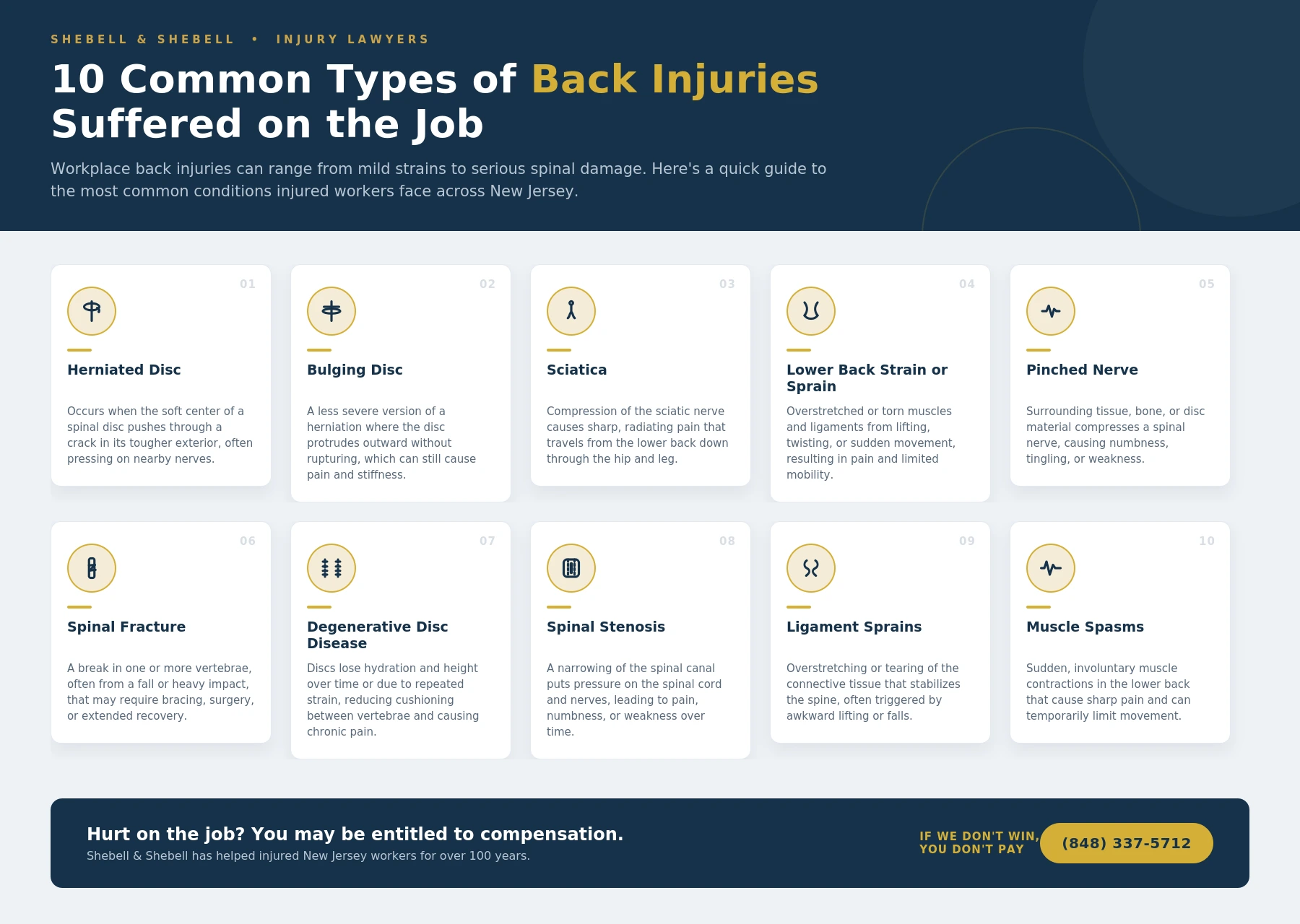
Back injuries can involve muscles, ligaments, discs, nerves, vertebrae, or several structures at once. The symptoms and treatment can vary considerably depending on what part of the back was injured.
Herniated Disc
The spine contains discs that act as cushions between the vertebrae. A herniated disc occurs when material from inside a disc pushes through its outer layer and may irritate or compress nearby nerves.
Workplace herniated discs can occur after:
- Heavy lifting
- Sudden twisting
- Falls
- Repetitive bending
- Forceful pushing or pulling
- Vehicle or equipment accidents
A herniated disc may cause localized back pain, but nerve involvement can also cause numbness, tingling, weakness, or pain that travels into the legs.
For workers with physically demanding jobs, these symptoms can make lifting, standing, sitting, bending, or walking difficult.
Bulging Disc
A bulging disc occurs when part of the disc extends outward beyond its normal position. Unlike a herniated disc, the outer portion of the disc generally remains intact.
Bulging discs may develop gradually from wear and repetitive stress, but lifting, twisting, or other workplace activity can contribute to symptoms or aggravate an existing disc problem.
Some people experience only back pain. Others may develop numbness, tingling, weakness, or radiating pain when the bulging disc puts pressure on a nearby nerve.
Sciatica
Sciatica describes pain and other symptoms caused by irritation or compression involving the sciatic nerve.
Pain commonly starts in the lower back and travels into the buttock, thigh, or leg. A worker may also experience:
- Tingling
- Numbness
- Burning sensations
- Weakness
Sciatica is not usually a separate injury by itself. It can result from conditions such as a herniated disc, bulging disc, spinal stenosis, or other problems that place pressure on spinal nerves.
For someone who stands, drives, lifts, or walks throughout the workday, sciatic pain can significantly interfere with normal job duties.
Lower Back Strain or Sprain
Lower back strains and sprains are among the most common workplace back injuries.
A strain involves muscles or tendons, while a sprain involves ligaments that help support the spine.
These injuries frequently result from:
- Lifting something too heavy
- Using improper lifting technique
- Repetitive bending
- Sudden twisting
- Overexertion
- Slips and falls
- Pushing or pulling heavy objects
Symptoms can include pain, stiffness, tenderness, reduced range of motion, and muscle spasms.
Although many strains and sprains improve with conservative treatment, more serious injuries can keep someone out of work for an extended period or make physically demanding duties difficult.
Pinched Nerve
A pinched nerve occurs when surrounding tissue places excessive pressure on a nerve.
In the back, nerve compression can result from disc problems, inflammation, spinal narrowing, or other changes affecting the space around the nerves.
Symptoms may include:
- Sharp or radiating pain
- Tingling
- Numbness
- Muscle weakness
- Burning sensations
Because spinal nerves extend into other parts of the body, a problem in the lower back can sometimes cause symptoms in the hips, buttocks, legs, or feet.
Spinal Fracture
A spinal fracture involves a break or crack in one or more vertebrae.
At work, these injuries may occur after significant trauma such as:
- Falls from ladders or scaffolding
- Construction accidents
- Vehicle crashes
- Being struck by equipment
- Crushing incidents
- Falls involving heavy impact
Some fractures are relatively stable, while others can affect the structural stability of the spine or place the spinal cord and surrounding nerves at risk.
Because spinal fractures can be serious, they may require extensive treatment and can lead to substantial time away from work.
Degenerative Disc Disease
Degenerative disc disease refers to changes in spinal discs that occur as they wear down over time.
It is not always caused by a single workplace accident. However, repetitive physical labor, frequent lifting, vibration, bending, twisting, or a particular work injury may aggravate an existing condition and make previously manageable symptoms significantly worse.
Symptoms can include chronic back pain, stiffness, limited movement, and pain that increases during certain activities.
For workers’ compensation purposes, the fact that a condition existed before an accident does not necessarily end the analysis. What matters can include whether workplace activity caused, aggravated, or contributed to the disabling symptoms.
Spinal Stenosis
Spinal stenosis is a narrowing of the spaces within or around the spine that can place pressure on the spinal cord or nerves.
It often develops gradually, but workplace activity may aggravate symptoms in someone who already has narrowing.
Common symptoms can include:
- Lower back pain
- Leg pain
- Numbness
- Tingling
- Weakness
- Difficulty standing or walking for extended periods
Jobs requiring prolonged standing, repetitive lifting, or substantial physical activity may become increasingly difficult when spinal stenosis causes persistent symptoms.
Ligament Sprains
Ligaments are strong bands of tissue that help stabilize the spine. A back sprain occurs when one or more of these ligaments are overstretched or torn.
Workplace sprains can result from sudden twisting, lifting, falls, awkward movements, or unexpected force.
They may cause pain, stiffness, swelling, and reduced mobility. More significant sprains can take time to heal and may temporarily prevent a worker from performing normal physical duties.
Muscle Spasms
A muscle spasm is an involuntary tightening of the muscles in the back.
Spasms may occur after:
- Muscle strain
- Overuse
- Heavy lifting
- Repetitive physical activity
- Other underlying back injuries
The pain can range from uncomfortable to severe. In some cases, a spasm can make it difficult to stand upright, walk normally, bend, or continue working.
Muscle spasms can also be a symptom of a larger back injury rather than the primary problem itself.
What Causes Back Injuries at Work?
Workplace back injuries are not limited to one type of accident. Some happen suddenly, while others develop after repeated stress over months or years.
Common causes include:
- Heavy lifting
- Repetitive lifting
- Bending and twisting
- Pushing and pulling
- Falls from heights
- Slips and falls
- Motor vehicle accidents
- Construction accidents
- Moving or repositioning patients
- Warehouse and material handling
- Prolonged awkward posture
- Repetitive physical labor
Certain occupations naturally expose workers to more of these risks. Nursing assistants, warehouse employees, construction workers, laborers, delivery drivers, maintenance workers, and truck drivers may spend significant portions of their workday lifting, carrying, bending, moving equipment, or maintaining the same posture for long periods.
Symptoms of a Work-Related Back Injury
Back injury symptoms can vary depending on whether the problem involves muscles, ligaments, discs, vertebrae, or nerves.
Common symptoms include:
- Localized back pain
- Stiffness
- Muscle spasms
- Reduced range of motion
- Pain extending into the buttocks or legs
- Tingling
- Numbness
- Weakness
- Difficulty standing, walking, lifting, or sitting for long periods
Some symptoms appear immediately after an accident. Others develop gradually or become more noticeable as swelling and inflammation increase.
When a Back Injury Becomes a Long-Term Work Problem
A back injury becomes much more serious when symptoms do not resolve and begin interfering with a worker’s ability to perform normal job duties.
Long-term problems can include persistent pain, recurring flare-ups, reduced lifting capacity, difficulty sitting or standing for extended periods, and permanent work restrictions. Some workers may be able to return only with modified duties, while others may be unable to return to the same occupation at all.
Treatment can also become more involved over time. Depending on the injury, a worker may need physical therapy, injections, ongoing pain management, or surgery. In more serious cases, the injury can result in permanent impairment.
These lasting effects can become especially important when a workers’ compensation claim moves beyond temporary treatment and into questions about permanent disability.
New Jersey Workers’ Compensation for Back Injuries
A work-related back injury may qualify for New Jersey workers’ compensation benefits when it arises out of and in the course of employment.
Back injuries are important to understand in the context of New Jersey’s disability system because the 2026 Schedule of Disabilities does not list the back as a scheduled body part in the same way it lists the hand, arm, leg, foot, eye, and other specific body parts. Instead, the schedule includes a partial total category based on 600 weeks, which can be relevant when evaluating permanent disability involving the back.
Medical Treatment and Temporary Disability
Qualifying workers’ compensation claims can provide medical treatment related to the injury and temporary disability benefits when the worker is unable to work for a period of time.
For 2026, New Jersey’s schedule states that temporary disability is calculated at 70% of wages, subject to a maximum weekly rate of $1,199 and a minimum weekly rate of $320, for up to 400 weeks.
The exact amount depends on the worker’s wages and the circumstances of the claim.
Permanent Disability After a Back Injury
Some back injuries continue causing limitations even after treatment reaches a point where further substantial improvement is not expected.
The 2026 New Jersey schedule states that permanent partial disability compensation is based on 70% of wages, while partial total disability is calculated using a 600-week framework. The schedule also lists total permanent disability at 70% of wages, subject to the applicable 2026 minimum and maximum rates.
There is no single percentage or dollar value that automatically applies to a herniated disc, spinal stenosis, strain, or other back condition. Medical findings, permanent functional loss, wages, and the facts of the individual claim all matter.
What to Do After a Back Injury at Work
Report the Injury
Tell your employer or supervisor about the injury as soon as possible.
Be clear about when it happened, what you were doing, and how the injury occurred. If there is an incident report or other workplace documentation, keep a copy when available.
Get Medical Care
Describe the accident and your symptoms accurately to the medical provider.
Mention pain, numbness, tingling, weakness, difficulty moving, or any symptoms traveling into the legs. Follow the treatment plan and work restrictions you are given.
Keep Records
Useful records may include:
- Medical records
- Work restrictions
- Incident reports
- Witness information
- Emails or text messages
- Pay records
- MRI, X-ray, or other diagnostic results
- Notes showing missed work or modified duties
Good documentation can help show both how the injury happened and how it has affected your ability to work.
Frequently Asked Questions About Back Injuries at Work
What Is the Most Common Type of Back Injury at Work?
Strains and sprains are among the most common workplace back injuries. They often result from lifting, bending, twisting, overexertion, or repetitive physical work.
Disc injuries, nerve compression, and other spinal conditions can also occur, particularly after more significant trauma or prolonged physical stress.
Can Lifting Cause a Herniated Disc?
Yes. Heavy lifting or lifting while bending or twisting can place substantial pressure on the spinal discs and may contribute to a herniated disc.
A disc injury can also result from repeated lifting over time or a sudden workplace accident.
Is Sciatica Covered by Workers’ Compensation?
It can be. Sciatica may be covered when it results from or is aggravated by a work-related injury or condition.
Because sciatica is usually a symptom of an underlying problem, such as a herniated disc or nerve compression, the medical cause of the symptoms is important.
Can Workers’ Comp Cover a Pre-Existing Back Condition?
Potentially. A pre-existing back condition does not automatically prevent a workers’ compensation claim.
If workplace activity or a work accident aggravated, accelerated, or worsened an existing condition, the circumstances may still support a claim. The medical evidence is especially important in these cases.
Can I Receive Workers’ Compensation for Degenerative Disc Disease?
Possibly. Degenerative disc disease often develops gradually, but work activity may aggravate or accelerate symptoms.
Whether benefits are available depends on the relationship between the worker’s job duties or accident and the resulting medical condition.
What if I Cannot Return to My Old Job After a Back Injury?
If permanent restrictions prevent you from returning to your prior work, that can become an important issue in your workers’ compensation claim.
The impact on your ability to lift, stand, sit, bend, drive, or perform other essential job duties may need to be documented through medical records and work restrictions.
How Are Permanent Back Injuries Compensated in New Jersey?
Permanent back injuries are not assigned one automatic value.
New Jersey’s 2026 disability schedule uses a partial total framework based on 600 weeks for permanent disability that is not tied to one of the specifically scheduled body parts. The final award depends on factors including the percentage of disability, wages, medical findings, and the facts of the claim.
Speak With Shebell & Shebell About a Work-Related Back Injury
Workplace back injuries can range from relatively straightforward strains to herniated discs, nerve compression, fractures, and chronic spinal conditions that permanently affect a person’s ability to work.
If you injured your back on the job, schedule a consultation with Shebell & Shebell’s workers’ compensation attorneys in NJ to discuss how the injury happened, how it is affecting your work, and what benefits may be available.